
For more than ten years in business, one question kept coming up: How do customers really choose their suppliers?
Then I moved into procurement and supply chain management—and the same question returned, just from the other side: How should we choose our suppliers?
I asked many experienced people in international trade, hoping for the “perfect answer.” Some said, “Ask someone you trust.” Others said, “Visit their factory.” A few even said, “See how many cars are in their parking lot.”
Every conversation taught me something, but the real answer still felt unclear.
Things finally became clearer when I began studying procurement and supply chain management in a structured way. Today, I’d like to share what I’ve learned with you.
The Two Main Stages
We can split the whole process into:
- Supplier Evaluation – before working together
- Supplier Management – after the partnership begins
1. Before Cooperation: How to Evaluate Suppliers?
During the initial selection phase, assess suppliers across these key areas:
- Financial stability
- Consistent quality & delivery history
- Current relationship status
- Production tech & R&D capability
- Service responsiveness
- Willingness to improve
- Total Cost of Ownership (TCO)
- Logistics & shipping capacity
- Information security
- Supply chain risk control
- Overall management level
Looking at these together helps pick suppliers in a more objective and scientific way—not just based on feelings or personal preference.
2. After Cooperation: How to Manage Suppliers?
Choosing a supplier is only the start. Keeping track of their performance is what ensures smooth, long-term cooperation and reliable deliveries.
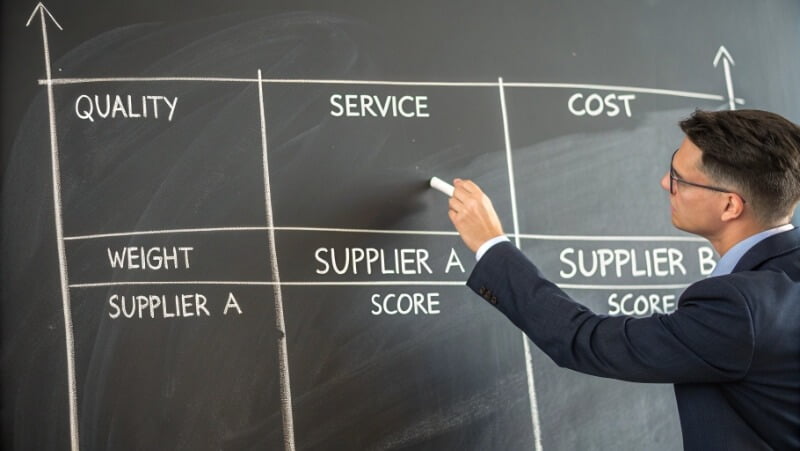
Use a supplier performance scorecard to measure and score different areas. This helps decide:
- Whether to keep the supplier
- How closely to work with them
- How to share resources
Key points to track:
- Meeting customer requirements
- Production capacity & utilization
- On-time delivery rate
- Quality control system
- Range of products offered
- Financial health
- Employee retention
- E-commerce capability
- Business sustainability
- Past cases & references
- Current workload & capacity
- Management of in-house vs. outsourced work
- Order lead time & production planning
- Flexibility to handle changes
Summary
This structured approach helps move from selecting to managing suppliers in a clear, rational, and systematic way.
For Sales Teams
This model isn’t just for buyers.
As a supplier, you can also use it to check your own performance:
See how close you are to being your customer’s “ideal supplier”—and keep improving step by step.
Leave a Reply